Zipwake PRO vs Seakeeper Ride
Underway Stabilization Comparison
Zipwake PRO vs. Seakeeper Ride
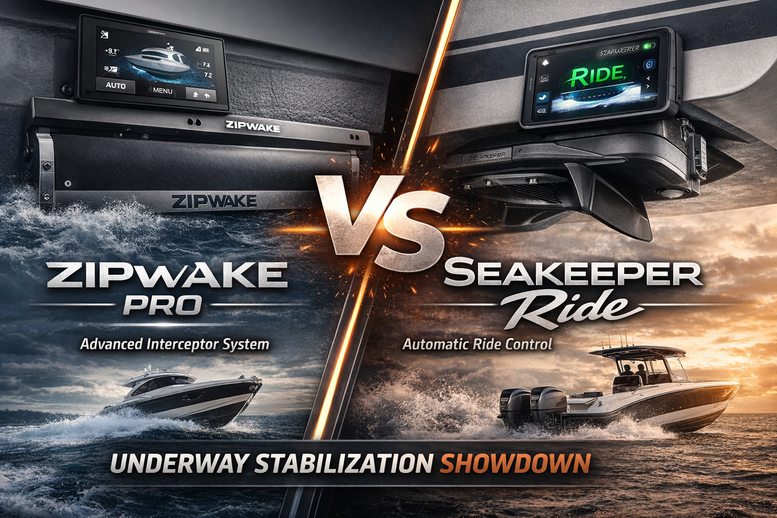
Both systems improve running attitude, visibility, and comfort. The real decision is not which brand name sounds more impressive - it is which system fits your hull, transom layout, and control goals more intelligently.
Quick navigation
At a glance | Fast technical takeaways | Technical comparison | Transom geometry | Which should you choose?
At a Glance
Seakeeper Ride
Best for owners who want a very automatic, packaged system on a boat that already fits Ride's controller layout and product range cleanly.
- Rotary blade control system
- Very appliance-like ownership experience
- Strong option for cleaner, simpler transoms
Zipwake PRO
Best for harder transoms, more complex hulls, and buyers who want more flexibility in lift distribution, integration, and long-term system design.
- Interceptor-based control
- Multiple geometry-specific hardware choices
- Stronger fit for tailored solutions
Fast Technical Takeaways
Control Philosophy
Ride is a packaged automatic system. Zipwake PRO behaves more like a configurable lift-management platform. That difference matters more than most buyers realize.
Boat Size and Scope
Seakeeper Ride now reaches much farther upmarket than many people think, but Zipwake PRO still covers a broader range overall when larger or more specialized boats enter the conversation.
Geometry Options
Zipwake PRO's biggest technical advantage is not just speed - it is the ability to solve real transom problems with different interceptor forms and placements.
Integration Flexibility
Zipwake PRO has the more modular integration story. Ride has the simpler ownership story. Which matters more depends on whether the boat is simple - or not.
Technical Comparison
What the Technical Specs Mean in Real Life
When Seakeeper Ride makes sense
If the hull already fits Ride's package cleanly and the owner wants a system that works in the background with very little setup thought, Ride is attractive. It is especially appealing when the goal is straightforward automatic control rather than fine-tuning how lift is distributed across the transom.
When Zipwake PRO becomes the smarter spec
If the transom has tunnels, tight twin-engine spacing, strong chines, unusual curvature, or a bracket layout that limits easy controller placement, Zipwake PRO usually offers more intelligent ways to recover usable lift and improve overall fitment.
Why Transom Geometry Changes the Whole Conversation
This is where a knowledgeable comparison separates itself from a generic one. Not every boat offers the same usable transom span, and not every hull gives you the same clean mounting real estate. A system that works beautifully on one boat can become compromised on another simply because the geometry is different.
Zipwake PRO has real technical credibility here because it offers multiple interceptor forms for specific jobs. V-shaped interceptors can use the space between twin outboards or sterndrives more effectively. Intermediate models help where propeller clearance is tight. Tunnel interceptors help recover control area over prop tunnels. Chine interceptors move lift farther outboard. Round interceptors work better on convex hull sections than straight blades do.
That does not automatically make Zipwake PRO better on every boat. It does mean that when the transom is difficult, the system gives the installer more ways to engineer a better answer.
Two Common Buyer Scenarios
Scenario A
Straightforward center console or bay boat
If the boat is cleanly laid out and already lands in Seakeeper Ride's product range with no major geometry complications, Ride can be a very strong choice for buyers who want simplicity first.
Scenario B
Stepped hull, bracket boat, or tunnel transom
If the transom is crowded or hydrodynamically complicated, Zipwake PRO often becomes the more technical and more adaptable option because the control surfaces can be tailored more intelligently to the available space.
Which One Should You Choose?
Choose Seakeeper Ride if your boat fits the package cleanly and your top priority is a highly automatic stabilization system with minimal setup complexity.
Choose Zipwake PRO if your boat has more complex geometry, tighter installation constraints, or you want more control over span, lift placement, and system integration.
The more technical the installation becomes, the stronger the case tends to become for Zipwake PRO.
Need Help Choosing the Right System?
Send us your boat length, beam, engine setup, transom photos, and cruise speed. We can help you determine which Zipwake PRO kit is the better fit for your hull and how you actually use the boat.
Recent Posts
-

SeaStar Hydraulic Steering Spring Checklist | Fluid, Seal Kits & Bleeding
Get Your SeaStar Hydraulic Steering Ready for Spring If your boat has been sitting through the winte …11th Mar 2026 -
Sleipner (Side-Power) Thrusters: The Complete Guide to Bow & Stern Thrusters, Controls, and Installation
Updated: February 2026 The Complete Guide to Sleipner Bow & Stern Thrusters (Side‑Power): Choosing …26th Feb 2026 -
3 Essentials for Upgrading Your Old Engine Controls (Plus a Quick System Selector)
3 Essentials for Upgrading to the NHK MEC KE System (and How to Pick the Right One) If your boat st …17th Feb 2026